




phonometry#
phonometry — the measurement of sound. Formerly published as PyOctaveBand.
Acoustic measurement toolkit for Python: fractional octave-band filter banks, frequency and time weighting, and sound level metrology — conformance-tested against IEC 61260-1:2014 / ANSI S1.11-2004 (filters) and IEC 61672-1:2013 (weighting and levels) class 1 tolerance limits.
✨ Highlights#
- 🎛️ 1/1, 1/3 and arbitrary fractional octave filter banks (stable SOS + multirate decimation)
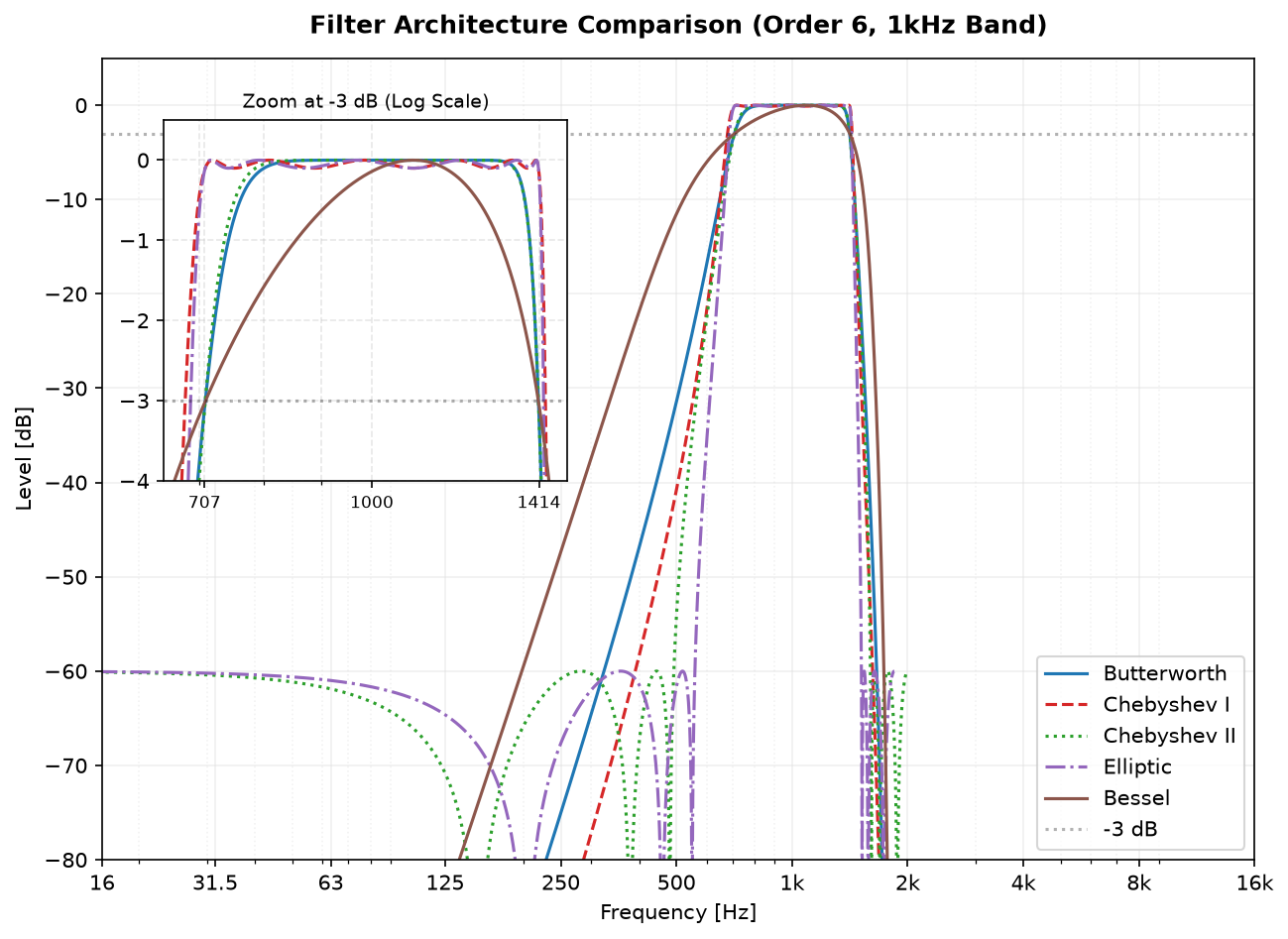
- 🏗️ Five architectures: Butterworth, Chebyshev I/II, Elliptic, Bessel — all with −3 dB points on the ANSI band edges
- 🔊 A/C/Z frequency weighting within IEC 61672-1 class 1 tolerances
- ⏱️ Fast/Slow/Impulse time ballistics,
Leq,LAeqandL10/L50/L90statistical levels - 🗺️ Octave spectrogram (band levels over time) and zero-phase offline filtering
- 🧠 Loudness in sones three ways: Zwicker (ISO 532-1 Annex B validated), Moore-Glasberg stationary & time-varying (ISO 532-2/3) and Sottek Hearing Model (ECMA-418-2); DIN 45692 sharpness, ISO 226:2023 contours
- 🎻 Sound-quality metrics: ECMA-418-2 tonality (tu_HMS) and roughness (asper)
- 🗣️ Speech Transmission Index: STI and STIPA per IEC 60268-16 Ed. 5, with signal generator
- 🎯 Tone prominence (TNR/PR, ECMA-418-1), environmental Lden/Ldn (ISO 1996-1), IEC 61252 noise dose
- ↗️ Two-microphone sound intensity (IEC 61043) with ISO 9614-1 field indicators
- 🏛️ Room & building acoustics: swept-sine/MLS impulse responses (ISO 18233), EDT/T20/T30/C50/C80/Ts (ISO 3382-1/2), open-plan speech metrics (ISO 3382-3), field airborne + impact + façade insulation with R′w/DnT,w/L′nT,w/D2m,nT,w and C/Ctr/CI (ISO 16283-1/2/3, ISO 717-1/2), laboratory R/Ln (ISO 10140), flanking-transmission prediction of R′w/L′n,w (EN 12354-1/2), measurement uncertainty (ISO 12999-1), sound absorption (ISO 354)
- 🌬️ Outdoor propagation & occupational exposure: atmospheric absorption α(f) (ISO 9613-1), the ISO 9613-2 general method (divergence + atmospheric + ground + barrier terms) with a per-term octave-band breakdown, and daily noise exposure LEX,8h with task/job/full-day strategies and Annex C uncertainty (ISO 9612)
- 🔊 Sound power LW three ways: enveloping-surface pressure (ISO 3744/3746), reverberation-room precision with Waterhouse/C1/C2 (ISO 3741), intensity scanning with field indicators and grade (ISO 9614-2)
- 📏 Physical SPL calibration with IEC 60942:2017 stability validation, and dBFS modes
- ⚡ Vectorized multichannel processing and stateful block (real-time) workflows
🚀 Installation#
pip install phonometry
Optional extras: phonometry[plot] (matplotlib for response plots and result .plot() methods), phonometry[perf] (numba for faster impulse ballistics), phonometry[full] (both).
📚 Documentation#
Full documentation website: https://jmrplens.github.io/phonometry/ (English / Español)
Or browse the Markdown docs on GitHub:
| Page | Contents |
|---|---|
| Getting Started | Installation, first analysis, WAV files |
| Filter Banks | Architectures, response gallery, band decomposition, zero-phase |
| Frequency Weighting | A/C/Z curves, class 1 high-accuracy mode |
| Time Weighting | Fast/Slow/Impulse ballistics, initial state |
| Levels | Leq, LAeq, percentiles, LCpeak, SEL, noise dose (IEC 61252), Lden and rating levels (ISO 1996-1), octave spectrogram |
| Occupational Exposure | ISO 9612 task-based, job-based and full-day strategies with the Annex C uncertainty budget (LEX,8h + U) |
| Tone Prominence | ECMA-418-1 tone-to-noise ratio and prominence ratio with frequency-dependent prominence criteria |
| Psychoacoustics | Zwicker (ISO 532-1), Moore-Glasberg (ISO 532-2/3) and Sottek (ECMA-418-2) loudness, sharpness (DIN 45692), equal-loudness contours (ISO 226), tonality & roughness (ECMA-418-2) |
| Speech Transmission | STI/STIPA (IEC 60268-16): modulation transfer function, indirect method from impulse responses and direct STIPA measurement |
| Speech Intelligibility Index | SII (ANSI S3.5-1997): band importance, masking and audibility, the index in noise and hearing loss, standard vocal-effort spectra |
| Sound Intensity | Two-microphone p-p intensity (IEC 61043), ISO 9614-1 field indicators |
| Room Acoustics | Impulse responses (ISO 18233), room parameters (ISO 3382-1/2), open-plan metrics (ISO 3382-3), sound absorption (ISO 354) |
| Building Acoustics | Field airborne + impact + façade insulation and weighted ratings (ISO 16283-1/2/3, ISO 717-1/2), laboratory characterisation (ISO 10140), flanking-transmission prediction (EN 12354-1/2), measurement uncertainty (ISO 12999-1) |
| Outdoor Sound Propagation | Atmospheric absorption α(f) (ISO 9613-1) and the ISO 9613-2 general method: geometrical divergence, atmospheric absorption, ground effect, barrier screening and meteorological correction |
| Sound Power | Sound power level LW by enveloping surface (ISO 3744/3746), reverberation room (ISO 3741) and intensity scanning (ISO 9614-2) |
| Calibration and dBFS | Physical SPL, digital full-scale, RMS vs peak |
| Block Processing | Stateful streaming workflows |
| Multichannel | Vectorized multichannel analysis, performance |
| API Reference | Every public function and class |
| Theory | Standards, math, design decisions |
| Why phonometry | IEC compliance verification vs other libraries |
| Conformance report | Live per-standard numerical validation (expected vs computed) regenerated by make conformance |
⚡ Quick start#
import numpy as np
from phonometry import octave_filter

fs = 48000
t = np.linspace(0, 1, fs, endpoint=False)
# Composite signal: 100Hz + 1000Hz
signal = np.sin(2 * np.pi * 100 * t) + np.sin(2 * np.pi * 1000 * t)

# Apply 1/3 octave filter bank
spl, freq = octave_filter(signal, fs=fs, fraction=3)

print(f"Bands: {freq}")
print(f"SPL [dB]: {spl}")
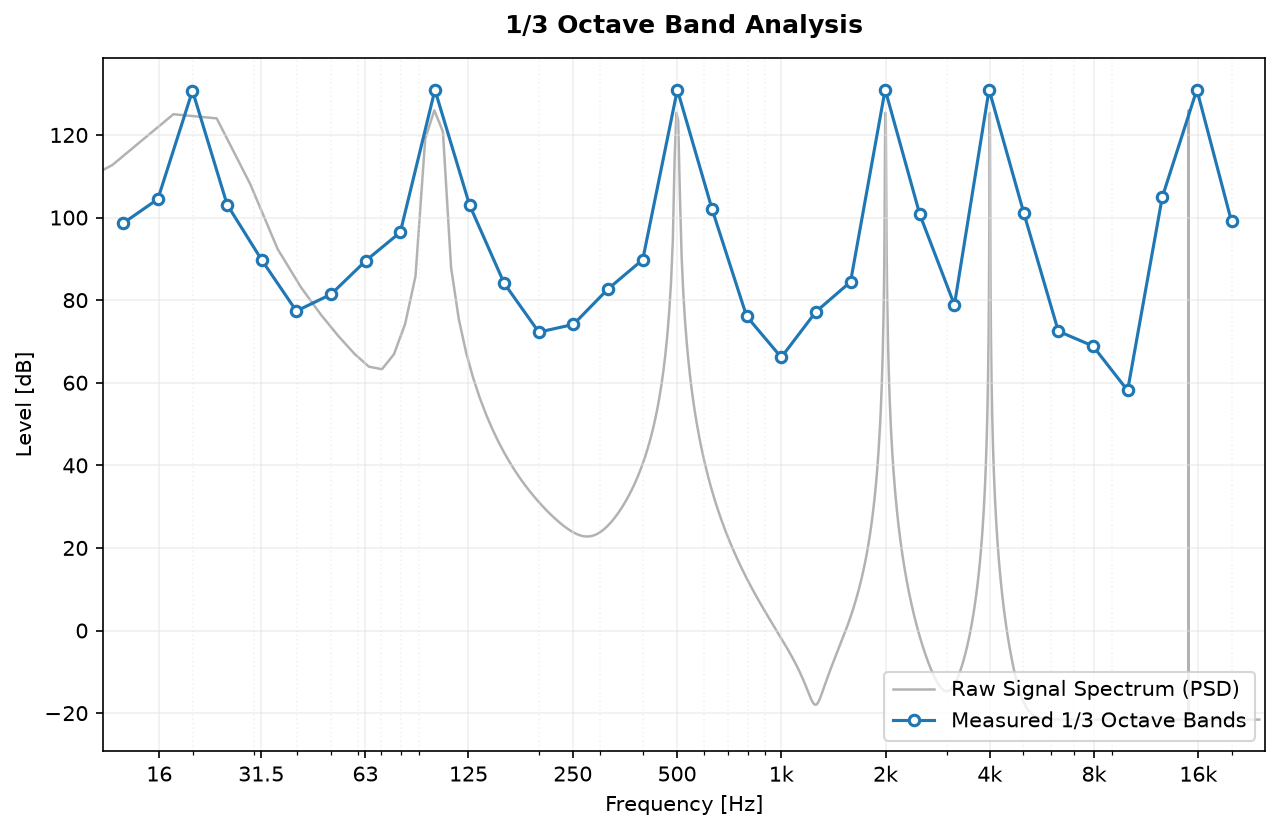
1/3 Octave Band spectrum analysis of a complex signal. More examples in the documentation.
🧪 Development#
make install   # dependencies + editable install
make check     # ruff + mypy + bandit + tests
make graphs    # regenerate documentation images
See https://github.com/jmrplens/phonometry/blob/main/CONTRIBUTING.md and the https://github.com/jmrplens/phonometry/blob/main/CHANGELOG.md